-
Blog
for all our ramblings & rants!

Traditional Wooden Gypsy Pegs
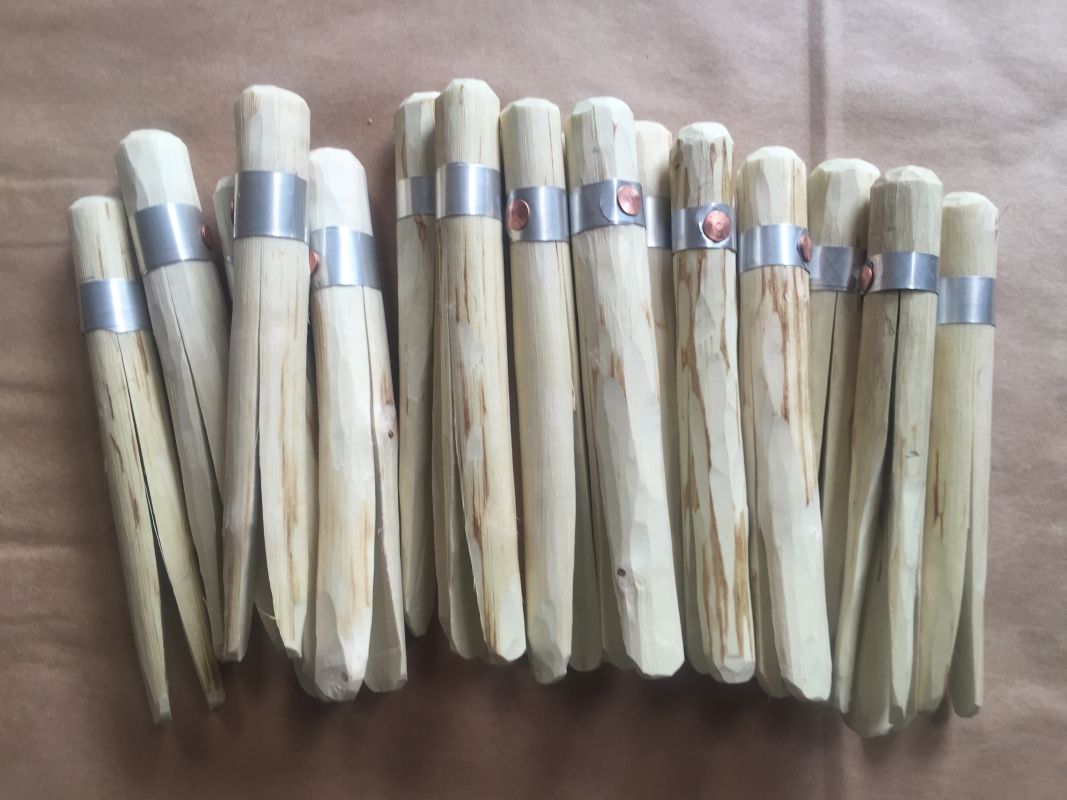
Gypsy pegs are an early type of clothes peg which were made by travelling farm workers, they were made in the winter months when there was very little farm work about and sold door-to-door to help supplement their income.

Gypsy pegs were traditionally made from Hazel or Willow which was foraged from the hedgerow.
Forage for a length of Willow or Hazel of approximately 5/8 inches in diameter and 12 inches in length. This will make two pegs. We always make a pair of pegs together as it is easier to hold and work on.
Use a knife to remove the bark, for best results after removing the bark allow to dry over night.

Next you need to get a use drinks can which you will cut into strips to make the band that go around the peg to stop it splitting. Cut the can into strips approximately 1/2 inch in width and and approximately 3.3/4 inches long.
Taper off one end of the aluminum strip and round off the other end, scissors are the best tool for this job.
Find the centre of the
prepared stick and mark, measure 1 inch each side of the center. This mark is where the bands are going to go to stop the pegs from splitting.
Use a crook
knife to make a slot in the side of the peg to allow the tapered end of
the aluminum strip to fit into.

Place the tapered end of the aluminum strip into the slot and wrap around the peg tightly - approximately 1-1/2 times.

Use a carpenters awl to make a pilot hole for the copper nail.

Then nail the band into position and repeat the process for the second peg. You will then have a stick with two aluminum bands on.

Next you will need to split open the stick to create the jaws of the peg, this is done with a knife. Placing a knife on the top of the peg at 90 degrees to the nail and then tap the back of the knife.

Gently twisting the knife to open the split up

The peg is shaped by removing material from the inside the jaws, this is done with a thin bladed knife.
Gypsies often used to make their own peg knives from old boned handled eating knives.
Once both of the pegs jaws have been shaped the pegs are separated by sawing in half. Then round off the ends.

The finished pegs were sold usually by the dozen either directly to shopkeepers or door-to-door